Monday, April 21, 2014

BEO Advisory Committee Concludes their Discussions…


Today we continued our discussions in the Barrow Arctic Science Center (BARC) with a focus on current research activities taking place on the BEO. I began with a presentation of the NGEE Arctic project and how we are working to bring together field and laboratory researchers and modelers. I emphasized that the Arctic Coastal Plain, with its mixed of distinct landscape features like polygons, thaw lakes, and drained thaw lake basins, provides a great opportunity to test our multi-scale observations and models in support of improved climate prediction. There was good discussion about our long-term goals and how the BEO could help us achieve those through logistical support. This encompassed not only what UMIAQ could do to assist us with our field studies, but also how laboratory space might be optimized for the types of research we would like to conduct locally as opposed to shipping samples back to our home institutions. Here the discussion turned to possibly providing resources like balances and drying ovens for sample preparation and analysis.

Craig Tweedie from the University of Texas at El Paso (UTEP) then presented an overview of several studies that he is conducting on the BEO and surrounding area. Craig and his students have worked in Barrow for many years. They have conducted extensive vegetation surveys and developed vegetation cover maps for the Barrow Peninsula. One of Craig’s passions involves finding historical research sites, for example those conducted as part of the International Biological Program (IBP), and resampling plots that were established in the 1970s. In so doing, he and his students have not only been able to identify and preserve sites and rescue datasets, but use those to map changes in vegetation and other landscape features over time. This is pretty fascinating research, especially given how some of this information can be applied to questions being asked about environmental change in the Arctic. A lot of these data can be found at the Barrow Area Information Database (BAID) web site (http://baid.utep.edu/).


We also heard a brief, but informative, presentation by Salvatore Losacco who worked in Barrow this winter and maintained a year-round eddy covariance system for measuring CO2 and CH4 flux from the tundra near the southern edge of the BEO. Salvatore is a marine biologist and oceanographer, and is providing technical support to a project led by Donatella Zona. Most eddy covariance systems are put up in the spring and taken down in the fall because as sensitive instruments they require a fair bit of maintenance during the harsh Arctic winters. I am not aware of any year-round measurements of CO2 and CH4 using the eddy covariance system; until now. And according to Salvatore, it was not easy to keep the instruments running given the cold and dark conditions. However, thanks to Salvatore and some exciting stories, it looks like they were successful and now this team has a lot of data to analyze, interpret, and then publish. This should be valuable information.

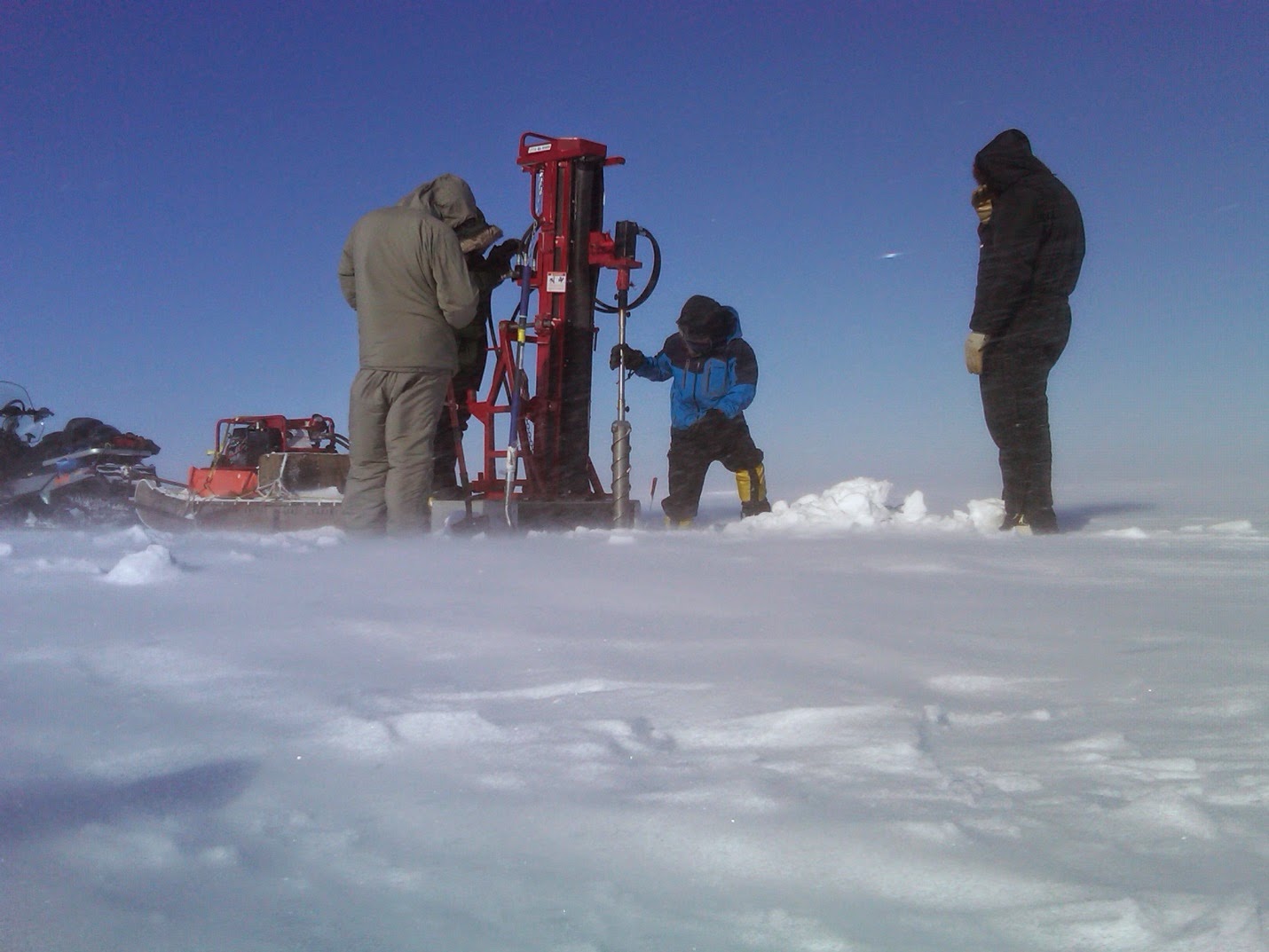
Tomorrow I will transition to field research. I will dust off our hydraulic drill rig, work with UMIAQ staff to change fluids, and then test the system in anticipation of others from ORNL and LBNL arriving next week. I also took a quick drive out towards our research site this afternoon and counted several dozen caribou in the distance. I understand that caribou have spent the last few months near Barrow and that we might expect some equipment damage given their numbers in the vicinity of our research plots. Apparently caribou are not too careful when grazing tundra interspersed with research instruments. Two years ago Arctic foxes created some headaches by chewing through cables and tubing to some of our equipment. These are the constant challenges of a field scientist!

Here are a few pictures of the terrestrial and marine environments near Barrow. The first picture shows the boardwalk and trail mat that protect the tundra from repeated foot traffic leading several miles out to our field plots that are covered in deep, hard-packed snow. As I took pictures, a snowy owl flew past me only a few inches above the ground. I'll be sure to keep an eye open for owls as we begin our field research. They are beautiful birds that we frequently see catching and carrying lemmings to their nests in the spring. The second picture shows that the Arctic Ocean is, as it should be this time of year, covered with sea ice. A little bit of clearing in the clouds helps differentiate land from sky. Otherwise it can be difficult to orient yourself relative to the horizon.


Thursday, April 17, 2014

A Day Discussing the Barrow Environmental Observatory…


While my primary focus in Barrow is science, it is important to point out that the NGEE Arctic team chose the Arctic Coastal Plain on the North Slope of Alaska as its initial area of research for a reason; the Barrow Environmental Observatory (BEO). The BEO encompasses 7,500 acres of Arctic tundra that was set aside by the village of Barrow for national and international research. Every year several hundred scientists come here to study Arctic ecosystems, both terrestrial and marine.  In addition to providing access to the outdoor laboratories, the community of Barrow has built a modern research facility where scientists can undertake analyses while away from their home institution. These resources, and logistical support provided by UMIAQ, have made it possible for our team to get off to a quick, productive, and safe start.

 
Resources like the BEO and the Barrow Arctic Research Center (BARC) must be managed so that these can sustainably meet the needs of a growing community of users. Therefore, an Advisory Committee has been formed to provide feedback on the policies and procedures for managing the BEO. Today was the first meeting of that advisory group. Our agenda was a simple one, but nonetheless the scope of which will grow given the significance of the Arctic and the North Slope of Alaska to climate-related research across multiple state and federal agencies, and private companies.
 
 
The advisory committee stayed focused today on the job at hand; how to protect the natural resource while ensuring that once in Barrow scientists have the support they need to be successful. This includes, but is certainly not limited to aspects of access (e.g., trail mat or boardwalks), power, and infrastructure. One of the challenges to managing any resource is anticipating the needs of scientists who are now, or in the future might decide, to work on the BEO. Tomorrow morning I will present an overview of the NGEE Arctic project and communicate our research needs for the coming year and beyond. Other scientists attending the meeting will do the same. In addition, we know that new projects will be located on the BEO in the coming years (i.e., NEON) and those requirements must also be considered in future planning.


Finally, the Barrow area has a rich history of Arctic research that will undoubtedly continue into the coming decades. The people of Barrow are well aware of the role they and their community have played in this endeavor. Scientists working on the BEO and in the larger surrounding area will need to stay focused if they are to keep pace with the increasing depth and breadth of questions being asked about the changing Arctic.

Wednesday, April 16, 2014

Travel Days to Barrow Are Always Long Days…


I have travelled to Alaska, and Barrow, several dozen times in the last three years. The trip is always exciting as I enjoy the anticipation of field research. The 4,600 mile flight, however, never gets any shorter or quicker. It still takes 16 to 18 hours; sometimes longer. My flight left Knoxville at 7:05am and, after a short layover, departed Chicago several hours ago, bound for Anchorage, and then to Barrow with stops in Fairbanks and Prudhoe Bay. Thanks to what I understand are 16 hour days right now and quickly getting longer, I will arrive 330 miles north of the Arctic Circle with plenty of sun still above the horizon.

While people like to talk about the science we are doing as part of the Next-Generation Ecosystem Experiments (NGEE Arctic) project, they are also quick to ask me about what clothing I take at this time of year to stay warm. Fortunately, experience and sage advice from others including our Chief Scientist Larry Hinzman (UAF) has given all of our team a good idea of what is required when working outside all day in sub-freezing weather. My Arctic insulated parka, insulated bibs, and tundra boots are all kept in our team “dry” storage area in Barrow. Most people on the project do that as well. It’s great not to pack those bulky items every time we travel. All other clothing including base layers, fleece, insulated vests, anoraks, wind pants, gloves, headwear, and goggles all fit into a couple of weatherproof duffle bags. The goggles and headwear come in especially handy because of the strong winds the blow across the open tundra and when riding snow machines to and from the field site which is located just a few miles to the southeast of Barrow. If people on the team forget an item or two there is a slim chance that it can be purchased in Barrow. Best advice is not to forget anything…


My flight does not arrive into Anchorage for another four hours; then northward to Fairbanks, Prudhoe Bay, and finally Barrow. I have plenty of time to prepare for Wednesday’s advisory board meeting for the Barrow Environmental Observatory (BEO). I’ll write more about that and my arrival into Barrow tomorrow. For now, I have plenty of time to read through Taniya’s draft Global Change Biology manuscript entitled “Stoichiometry and temperature sensitivity of methanogenesis and soil respiration from saturated polygonal tundra in Barrow, Alaska”. In this manuscript, Taniya and her co-authors report on the mechanisms, as determined by incubation studies across a range of temperatures that underlie CO2 and CH4 release from active layer soils and permafrost. Taniya, David, Beth, Baohua, and others draw some interesting conclusions about soil organic matter (SOM) decomposition, microbial metabolism, and iron reduction. It is great to see tangible progress being made in so many areas of the project!


Tuesday, April 15, 2014

A New Field Season Begins in Barrow…


It has been almost 5 months since we were last at our NGEE Arctic field site in Barrow. During that time air temperatures dipped to -35F in late December, but otherwise have been mild for locations throughout the North Slope of Alaska. NOAA reports that January was unseasonably warm across much of Alaska.


Although warmer than average, we still expect cold temperatures and snow as we conduct field work during the April 16 to May 4, 2014 period. I will arrive in Barrow ahead of others for a two-day meeting of the Barrow Environmental Observatory (BEO) Science Advisory Board. The BEO is approximately 7,500 acres of pristine tundra that the Native Village Corporation set aside for national and international Arctic research. It is a tremendous resource and one used by many research projects, including NGEE Arctic. Once the BEO Science Advisory Board meeting concludes, then I will be joined by other scientists from Oak Ridge, Los Alamos, and Lawrence Berkeley National Laboratories, and the University of Alaska Fairbanks. As we have done before, this group will undertake almost two weeks of field research that will include geophysical characterization of land across the BEO, sampling of deep permafrost using a hydraulic drill rig, and then preparations by our team of hydrologists for the upcoming spring snowmelt.


If you are new to the NGEE Arctic blog – welcome! You might be interested to know that Barrow, 330 miles north of the Arctic Circle, holds the distinction of being the northernmost city in the United States. It is also listed among the top 10 northernmost settlements in the world. Barrow has been home to Native Inupiat people for over 1,000 years and was named after Sir John Barrow, an English statesman and writer. Barrow is ca. 1,300 miles south of the North Pole.

 
In addition to our two weeks of field research, we will also be hosting (hopefully) a live Google Hangout broadcast from Barrow on April 24, 2014. Join us for that if you can. I will be sure to post details as that date gets closer and as details are finalized. We expect to broadcast live from the field as researchers conduct geophysical surveys using snow machines and collect cores of frozen soil or permafrost using a sled-mounted drill rig. We will be joined by scientists from two research labs in California. Plans also include talking about research in the Arctic, live with students from two high schools, one in Berkeley, CA and another in Anchorage, AK.


Stay tuned as it looks to be a busy trip as the NGEE Arctic project begins our third year of research on the North Slope of Alaska.


Wednesday, April 9, 2014

Join us for first trip to the North Slope of Alaska in 2014


A team of scientists from the NGEE Arctic project travel to Barrow in mid-April to collect permafrost cores and conduct geophysical surveys across the Barrow Environmental Observatory. Join them as they begin the 2014 field season on the North Slope of Alaska.  Follow trip…

Wednesday, January 8, 2014

Strong participation by NGEE Arctic scientists in annual AGU meetings


The American Geophysical Union (AGU) meetings are held each fall in San Francisco, CA. This meeting attracts more than 18,000 attendees and has become an important destination for scientists studying a broad range of topics in the earth and space sciences.


http://sites.agu.org/

Last year the NGEE Arctic team had a strong presence in the meeting and this year that trend continued with outstanding participation in the meeting. More than 60 abstracts were submitted for poster and oral presentations on topics that ranged from geophysics, hydrology, geomorphology and landscape evolution, plant physiology and vegetation dynamics, biogeochemistry, and data management. There were many excellent posters and presentation on multi-scale modeling, including fine-scale simulations of polygons to global-scale feedbacks due to a changing climate in the Arctic. In addition to the efforts of NGEE Arctic to showcase their science, our team proposed and organized 10 sessions. Many of these focused exclusively on Arctic ecosystems or otherwise addressed topics that our team is dealing with specifically in areas, for example, of scaling and remote sensing.  These are important topics for all ecosystems, not just the Arctic, and it was good to get input on how scientists working in other locations around the world are tackling this common challenges.

Finally, several members of the NGEE Arctic team participated as judges for the Outstanding Student Poster and Presentation awards. This was a great opportunity to learn about research being conducted by our next-generation of scientists. I found myself interested in several posters, in particular those that combined an interesting scientific question with innovation in either measurements or modeling as tools to address that question. I walked away from poster and oral presentations with a good sense of how young scientists are tackling important questions in various fields.
The NGEE Arctic team developed a booklet of abstracts and session descriptions. That booklet can be downloaded here....

Tuesday, January 7, 2014

Logistical Provider UMIAQ Enjoys Great Visibility at AGU


The NGEE Arctic team had a strong presence at the recent AGU meetings in San Francisco. While our team was busy throughout the week with posters, presentations, special sessions, and Town Halls, it was great to see that UMIAQ, our logistical provider in Barrow was also enjoying a great time over in the exhibition hall. Their booth was well-positioned and staffed by people we have come to know and respect over the last few years including Karl Newyear (Chief Scientist), Dominique Fox (Project Coordinator), Brower Frantz (Field Logistics Supervisor), Cindy Shake (Marketing and Communications Manager), and Nagruk Harcharek (Science Logistics Manager). Karl, Brower, and Dominique have helped us with permitting, lodging, vehicles, laboratory space, and technical support in Barrow for the last three years and have played a big part in getting our science off to a strong start. We have always felt safe and well-supplied thanks to their involvement with our NGEE Arctic team. Cindy and Nagruk are relatively new to UMIAQ but we look forward to working with them in the coming year. As the pictures kindly provided by UMIAQ show, the booth was well designed to engage those walking through the exhibition hall, and all the staff were welcome to talk about science and logistical support in Alaska and the North Slope. Everyone enjoyed seeing a glimpse of the Arctic in San Francisco. I saw numerous UMIAQ backpacks, brochures, and Barrow snow globes throughout the week.  I visited the booth several times just to say “hi” and get a head start with some of our planning for the upcoming field season that will begin for us in April.